

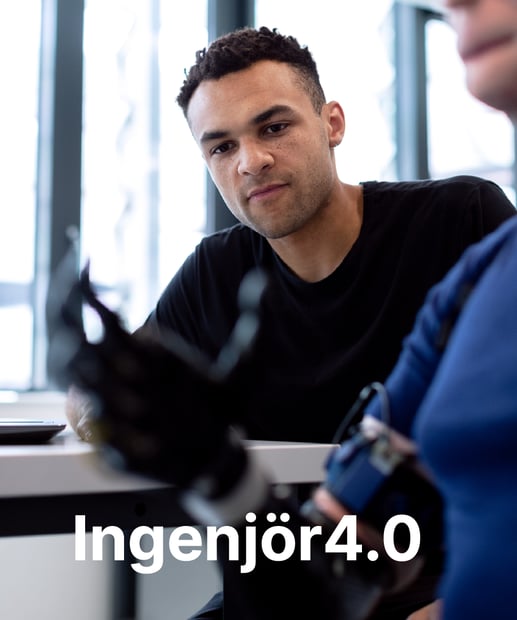

Human Robot Collaboration

MODULE DEVELOPED BY INGENJÖR4.0

Introduction to Human Robot Collaboration

Start date
Autumn 2025

Time commitment
Approx. 4 hours per week over
5 weeks (20 hours in total)

Please note
A minimum of 10 participants is required
for the module to start.

Ingenjor-4.0-cover

This module introduces different aspects one must consider while enabling human-robot collaboration

This module is designed to equip you with the knowledge of how robots can be effectively used in collaborative tasks. You will also gain insights into the tools and techniques that are employed to assess product and workstation design, as well as robot applications, with a focus on safety, flexibility, productivity, and ergonomics. Furthermore, this module will guide you on how to initiate the process of enabling human-robot collaboration.


Line-AIBL

The schedule

Starting date: Autumn 2025

TBD — 1st Webinar – “Virtual Discussion I”

TBD — 2nd Webinar – “Virtual Discussion II”

TBD — 3rd Webinar – “Virtual Discussion III”

Learning objectives

Learn to create a requirement specification for Human-robot collaborative workstations.
Apply at least one design method used for product or production design related to HRC.
Evaluate the pros and cons of an HRC-Station in terms of cost, safety, productivity or flexibility.


Module structure

The module based on a set of recorded lectures, self-study materials, webinars, and exercises.

Targeted participants

  • Production/Manufacturing Engineers and managers.


Content

1. Module Introduction (10 min)
  • Module content
  • How to contact me!
2. Know your current system (3 hours)
  • About this module (3 min)
  • Physical levels of Automation in a production system (30 min)
  • Challanges and barriers (30 mins)
  • Task and function allocation (30 min)
  • Virtual Discussion (60 min and about 30 min preperation)
  • Summary of part 1
3. Market analysis (4 hours)
  • About this module (3 min)
  • Traditional Industrial robot and industrial robot designed for
    collaborative applications (30 minutes)
  • Other factors to consider for implementation (30 minutes)
  • More enabling technologies (60 minutes)
  • Human-Robot Teams (30 minutes)
  • Virtual discussion Il (90 minutes)
  • Summary part 2
4. Future system design (4 hours)
  • About this module (3 min)
  • Level of Interaction (30 minutes – additional 30 min for article reading)
  • Automation strategies (20 minutes – additional 20 minutes for reading
    articles)
  • Operation and change management (30 min – additional 30 min for
    article reading)
  • Virtual discussion III (90 min)
  • Summary part 3
5. Module Finish (10 minutes)
  • Summary
  • Survey
  • Certificate


Time commitment

To complete this module, the participant is expected to schedule approximately 4 hours per week over 5 weeks (20 hours in total).

Important
Please note that a minimum of 10 participants is required for the module to start.

After applying to the program, please secure dates in your calendar to be able to join planned webinars and assure time available required for learning.

Partners

 chalmers-university-technology